
Most camera manufacturers followed the same playbook. They built full-frame sensors, added megapixels, made cameras bigger to fit larger sensors, and called it progress. Fujifilm looked at that roadmap and went a completely different direction.
I find that fascinating. A company that dominated film photography for decades, manufactured some of the finest optics ever made, and when digital arrived, they asked different questions and came up with different answers.
Fujifilm's Digital Journey: From Film Giant to Digital Outsider
Fujifilm's entry into serious digital photography came late by industry standards. They spent decades making film cameras and producing some of the world's finest film stocks. When the digital transition accelerated in the early 2000s, they struggled.
The FinePix era (late 1990s through 2011) was mostly forgettable. Consumer compacts and bridge cameras with mediocre sensors. The SuperCCD sensor technology was interesting on paper but never competitive with mainstream offerings. They had professional medium format digital backs, but those were niche products for studio work. Nothing that could compete with Canon's 5D or Nikon's D700 for serious photography.
Then in 2011, Fujifilm announced the X100. A fixed-lens camera with a 23mm f/2 lens (35mm equivalent), APS-C sensor, hybrid optical/electronic viewfinder, and retro styling that looked like a 1960s rangefinder. The camera industry was confused. Fixed lens? APS-C? Physical dials? None of this made sense for a serious camera in 2011.
The X100 became a sleeper hit. Street photographers loved it. Travel photographers wanted the compact size. Portrait photographers appreciated the rendering quality of that 23mm f/2 lens. Fujifilm stumbled into something important: there was a massive audience of photographers who didn't want another DSLR clone. They wanted something that felt different to shoot.
The X-Pro1 followed in 2012, introducing the X-Trans sensor and launching the X-mount interchangeable lens system. Fujifilm's declaration that they were serious about digital cameras. Not just making another camera system, but creating an alternative approach entirely.
The X100 Phenomenon: How a Niche Camera Went Viral
Fast forward to 2023-2024. The X100V, released in 2020, suddenly became impossible to buy. Wait lists stretched 6-12 months. Used prices on eBay exceeded retail. TikTok and Instagram exploded with X100V content. Fujifilm couldn't manufacture them fast enough.
What happened? Several things converged. The pandemic created interest in hobbies that got you outside. Film photography's resurgence made people want "the film look" without dealing with film costs and processing. Social media algorithms loved the specific aesthetic that Fujifilm's film simulations produced—especially Classic Chrome and Eterna. The camera became a cultural object. People who had never owned a dedicated camera before were buying it as a lifestyle accessory that happened to take great photos.
Fujifilm released the X100VI in February 2024 with a 40-megapixel sensor, in-body stabilization, and improved autofocus. The demand was even more intense. The camera sold out globally within hours. As of early 2026, shipping times for new orders still run 3-6 months depending on region.
The X100 series proved something important: a large segment of photographers value shooting experience, size, and aesthetic output over technical specifications. The camera has a fixed 23mm lens, no interchangeable optics, relatively slow autofocus, and costs $1600. On paper it should be a niche product. Instead it became one of the most sought-after cameras in recent memory.
This success validated Fujifilm's entire approach. They didn't need to compete with Sony's full-frame autofocus or Canon's megapixel race. They carved out their own space by prioritizing different values entirely.
The X-Mount System: Understanding the Lineup
Fujifilm's X-mount system splits into distinct series, each targeting different shooting styles:
X-T Series (Enthusiast/Pro SLR-style) - Traditional SLR body with centered viewfinder and three command dials on top. The X-T5 and X-T4 represent the core of the system. Heavy dial control, weather-sealed, designed for serious photography across all genres.
X-Pro Series (Rangefinder-style) - Offset viewfinder with Fujifilm's hybrid optical/electronic system. Compact, discrete, favored by street and documentary photographers. The X-Pro3 hides the rear LCD to encourage viewfinder shooting.
X-H Series (Professional Video/Sports) - Larger bodies with integrated grips, designed for hybrid photo/video work. The X-H2S focuses on speed and autofocus, the X-H2 prioritizes resolution. Most video features, best AF performance in the lineup.
X-E Series (Compact Rangefinder) - Simplified X-Pro alternative. Smaller, lighter, electronic-only viewfinder. The X-E4 strips controls to bare essentials for travelers who want interchangeable lenses without bulk.
X-S Series (Entry Enthusiast) - Modern design without vintage styling. The X-S20 targets photographers transitioning from phones or budget DSLRs. Simplified controls, vlogging features, more accessible than the dial-heavy T and Pro models.
All share the X-mount, sensors, and film simulations. The choice comes down to ergonomics and intended use rather than image quality differences.
More Than Just Cameras: Fujifilm's Unusual Corporate Portfolio
When people think of camera companies, they think of companies that make cameras. Canon makes cameras, printers, and office equipment. Nikon makes cameras and precision optics. Sony makes everything electronic. Fujifilm is different. Their imaging division is only one part of a massive conglomerate.
This diversification wasn't random. It started from necessity. When digital photography began destroying the film industry in the early 2000s, Fujifilm had to move fast. Between 2004 and 2010, they spent $1.8 billion restructuring, cutting 15,000 jobs and closing factories across Europe, Japan, and the United States. But instead of just shrinking, they leveraged decades of film manufacturing expertise into entirely new industries.
Photographic film production is astonishingly complex. Color film consists of roughly 20 overlapping functional layers, each precisely coated to about 20 micrometers thick total. Manufacturing this requires near-semiconductor quality control. When you spend decades perfecting that level of precision manufacturing, you develop transferable expertise. Fujifilm recognized this and systematically reviewed every technology in their laboratories, eventually identifying six priority businesses beyond traditional photography.
Some diversifications were obvious extensions. X-ray systems, endoscopes, diagnostic equipment. The medical imaging division now generates more revenue than cameras ever did. Others came from unexpected technology transfers. Take Fujitac, for example. In the 1950s, Fujifilm produced TAC (triacetate celluloid) as the base layer for photographic film. Someone realized this material—highly transparent with a smooth surface—worked perfectly as protective covering for LCD polarizing layers. By the 2000s, Fujitac had become a billion-dollar business supplying the LCD industry for everything from calculators to televisions. Film technology literally became screen technology.
They produce industrial chemicals and photoresists for semiconductor manufacturing. They make advanced materials for displays and electronics. The Fujinon division manufactures broadcast television lenses, security camera optics, and cinema glass used in Hollywood productions.
They even make cosmetics. Fujifilm developed a skincare line called Astalift using collagen technology they originally developed for photographic film. It's popular in Japan. The connection sounds absurd until you understand the technical crossovers. Making photographic film taught Fujifilm three things: how to work with emulsions (suspending one substance in another), how to prevent oxidation (the aging process that degrades both photos and skin), and how to manipulate collagen (the major ingredient in gelatin used for film bases). They took those competencies and applied them to skincare. It sounds strange, but the chemistry is nearly identical.
This matters because Fujifilm doesn't rely on camera sales for survival. When the film industry collapsed—global demand for color film declined 20-30% annually starting in 2001—Fujifilm's diversified business model saved them. While Kodak's sales dropped from $11 billion in 2005 to $5.9 billion in 2010, Fujifilm's sales grew nearly 50% over the same period. Their camera division has the freedom to take risks because it's not carrying the entire company. They could commit to X-Trans sensors even when early adoption was rough. They stuck with APS-C when everyone said full-frame was the future. They can focus on continuous improvement through firmware updates rather than forcing customers to buy new hardware every year.
Much of this corporate history comes from Asianometry's excellent video Why Fujifilm Survived (& Kodak Didn't) which details how Fujifilm's R&D culture and willingness to cannibalize their own business allowed them to survive the digital transition.
The X-Trans Sensor: Solving a Problem Nobody Else Cared About
Every digital camera sensor uses a color filter array. The sensor itself is monochrome and only captures brightness. To get color, you need filters over each pixel. Most cameras use the Bayer array, invented in 1976 by Bryce Bayer at Kodak. A 2x2 repeating pattern: red, green, green, blue.
The Bayer array works fine. Billions of cameras use it. But the repeating pattern creates interference with fine details, causing moiré patterns and false color artifacts. Camera manufacturers solve this by putting an optical low-pass filter in front of the sensor, which slightly blurs the image to eliminate moiré. Fujifilm decided that was unacceptable. Why intentionally blur your image?
Their solution was the X-Trans sensor, introduced in 2012 with the X-Pro1. Instead of a 2x2 Bayer pattern, X-Trans uses a 6x6 non-repeating pattern that mimics the random distribution of silver halide crystals in color film. The irregular pattern prevents moiré without needing an optical low-pass filter. You get sharper images with better fine detail resolution.
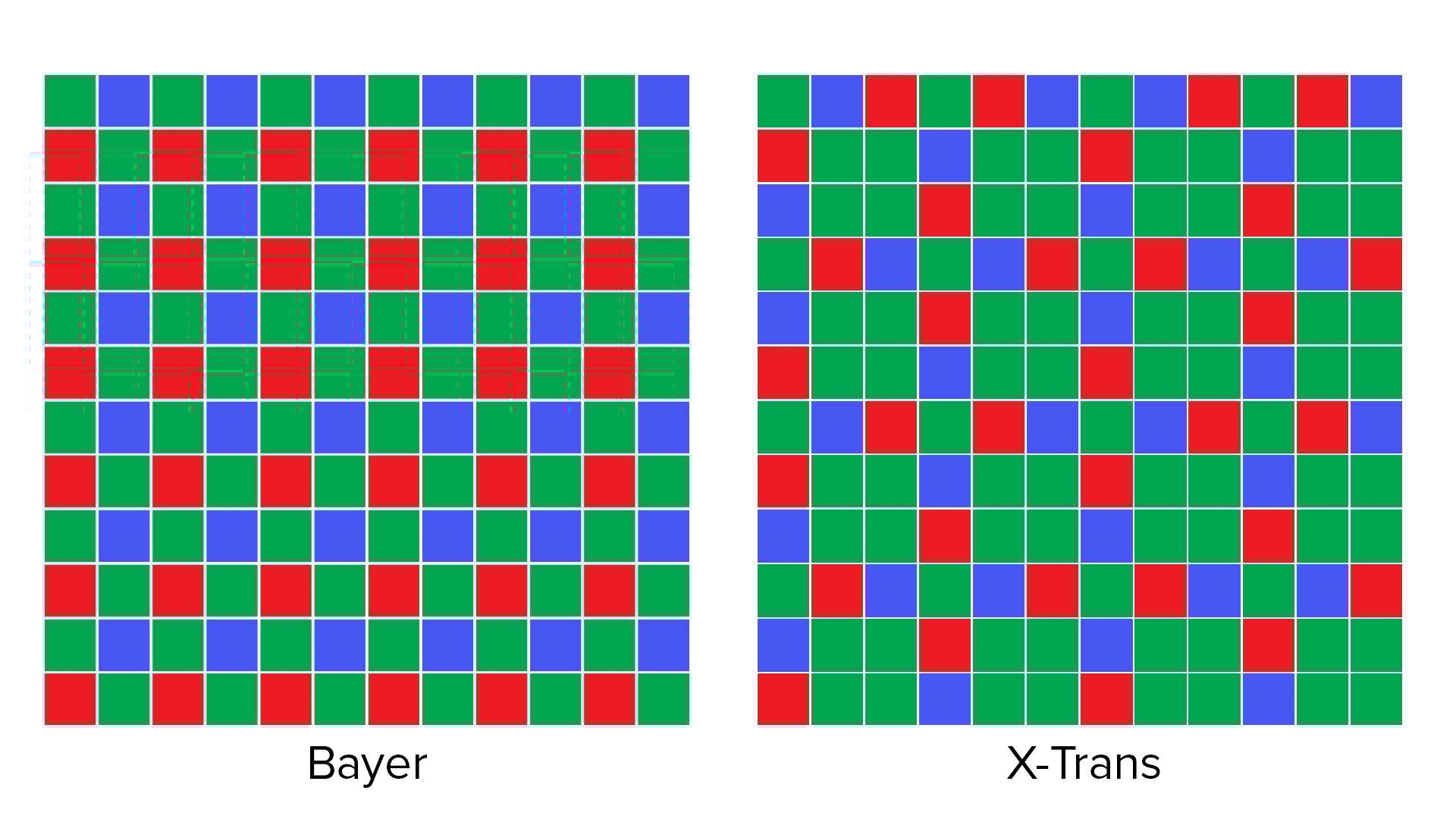
Visual comparison of Bayer array (left) and X-Trans array (right) sensor patterns. The X-Trans 6x6 non-repeating pattern eliminates moiré without requiring an optical low-pass filter.
Raw processing is more complex though. Early raw converters struggled with X-Trans files, producing worm-like artifacts in fine details. Adobe Lightroom took years to handle X-Trans properly. Some photographers still prefer using Fujifilm's own raw converter for this reason. But Fujifilm committed to the technology anyway. They believed the image quality benefits outweighed the processing complications.
Why APS-C When Everyone Else Went Full-Frame
Canon went full-frame with the 5D. Nikon followed with the D3. Sony built the A7 series around full-frame sensors. The industry consensus? Full-frame is superior, APS-C is a compromise for budget cameras.
Fujifilm stuck with APS-C. They manufacture sensors for other companies, so building a full-frame sensor wouldn't have been technically challenging. But APS-C made more sense for their design philosophy.
The Weight Difference Matters
| System | Body + Lens | Total Weight | Difference |
|---|---|---|---|
| Fujifilm X-T5 + 18-55mm f/2.8-4 | 557g + 310g | 867g | Baseline |
| Sony A7 IV + 24-70mm f/2.8 | 658g + 695g | 1353g | +56% heavier |
I feel that difference every day walking around Dresden. My X-T5 fits in a jacket pocket with the 35mm f/2. No dedicated camera bag needed. I actually bring it everywhere instead of leaving it at home because it's too heavy to bother with.
The image quality works for most purposes. The current X-Trans V HR sensors found in the X-T5 and X-H2 offer 40 megapixels, which is frankly absurd for APS-C. Even the previous generation's 26 megapixels was enough for prints up to 20x30 inches at 300 DPI. Most photographers never print larger than 16x20 anyway. The sensor performs well at high ISOs with usable images at 6400 and acceptable grain at 12,800. Full-frame gives you better low-light performance and shallower depth of field, but shoot at f/8 for landscapes or f/5.6 for street photography and the depth of field advantage vanishes. Modern APS-C sensors have closed the low-light gap significantly anyway.
Lens design gets simpler with the smaller sensor. Designing a sharp lens for APS-C is easier than for full-frame. The smaller image circle means less extreme optical corrections, especially at the edges. Fujifilm lenses stay consistently sharp corner-to-corner. Their 35mm f/2 lens is tiny, sharp, and costs less than comparable full-frame primes. Fujifilm did eventually release the GFX medium format system for photographers who need more resolution and dynamic range. But their core X-mount system remains APS-C, and they've shown no interest in changing that.
Film Simulations: When Heritage Actually Matters
Fujifilm manufactured film for 85 years before they built digital cameras. Velvia, Provia, Astia, Pro 400H, Acros—distinct film emulsions with specific color science, contrast curves, and grain structures, not marketing names. When Fujifilm built their digital cameras, they used their film emulsions as reference points. Each film simulation replicates the color palette, contrast, and tonal response of a specific film stock.
Film Simulation Characteristics
| Simulation | Color Profile | Best For | My Usage |
|---|---|---|---|
| Velvia | Highly saturated, vivid colors, lifted shadows | Landscapes | Incredible for nature but turns skin tones too red |
| Classic Chrome | Muted colors, deep shadows, desaturated blues/greens | Street, documentary | Use constantly for daily shooting |
| Provia | Neutral, accurate colors, moderate contrast | General purpose | The starting point for most people |
| Acros | Deep blacks, smooth tonals, controlled highlights | Black & white | Beautiful transitions without crushing shadows |
| Eterna | Flat, desaturated, cinema-style colors | Video, subdued looks | Great when you want that film look without post |
The color science is built into the camera's image processing pipeline. When you shoot JPEG, the camera applies these characteristics to the raw sensor data. The results look like actual film because they started with actual film as the reference point. Other manufacturers have picture styles or creative looks, but they feel generic by comparison. Fujifilm's simulations have specific personalities because they're derived from decades of chemical emulsion development.
I always shoot RAW with Fujifilm cameras. The flexibility matters—you can change film simulations afterward in software like Capture One or Lightroom, or even process RAW files directly in-camera using different film simulations after the fact. But Fujifilm is different. The JPEGs are so good that most of the time I don't need to touch the RAW files. They're there if I need them, but for the majority of images, the JPEG straight from camera is exactly what I want. With Canon or Nikon, shooting RAW was mandatory because their JPEGs felt flat and lifeless. I treat Fujifilm RAW files purely as a backup plan. The JPEGs are usually finished images the moment I press the shutter.
The Community and Recipe Culture
Fujifilm has built something unusual among camera manufacturers. A genuinely passionate community that shares film simulation recipes like chefs trading cooking techniques.
Websites like FujiXWeekly catalog hundreds of custom film simulation recipes. People spend hours tweaking highlight and shadow tones, color chrome effects, and grain settings to recreate specific film stocks or develop entirely new looks. Then they share the exact settings so others can load them into their cameras. It's collaborative in a way that doesn't really exist with other camera systems. If you shoot Fujifilm, bookmark FujiXWeekly. The recipe library alone is worth exploring for hours.
YouTube channels like Pal2Tech cover Fujifilm extensively. News about firmware updates, lens reviews, shooting techniques specific to the X-Trans sensor. The community actually cares about this stuff. There's real excitement when Fujifilm announces a new film simulation or releases a firmware update that improves autofocus. Canon and Nikon users don't get excited about firmware updates. Fujifilm users do. If you're considering Fujifilm or already shooting with their cameras, Pal2Tech is essential viewing for staying current with the system.
Part of this comes from Fujifilm actually listening to their users. They've added features through firmware that other manufacturers would have saved for the next camera model. The X-T3 got significant autofocus improvements years after release. The X-H2S keeps getting better with each update. Fujifilm treats their cameras as evolving platforms rather than disposable products.
The recipe sharing culture also means you can experiment endlessly without touching Lightroom. Load a recipe, shoot for a week, try a different one. Some people have dozens of custom settings saved for different situations. It keeps the shooting experience fresh and encourages experimentation.
Manual Controls: Analog Interface for Digital Technology
Most modern cameras bury settings in menus. You want to change ISO? Press the ISO button, navigate with a dial, press OK. Want to adjust exposure compensation? Find the +/- button, turn a dial, maybe press OK again.
Fujifilm cameras have physical dials. ISO dial on top. Shutter speed dial next to it. Aperture ring on the lens. Exposure compensation dial where your thumb naturally rests. You can see your settings at a glance even when the camera is off. Physical controls are faster once you learn them, and the design serves a purpose beyond nostalgia. You adjust ISO by feel without taking your eye from the viewfinder. You set your exposure before you raise the camera to your eye.
The dials show your current settings. The camera doesn't hide anything in a digital display that you have to turn on to check. Some Fujifilm cameras look like vintage SLRs with their dial-heavy design. The X-T series especially. Others mimic rangefinder cameras with hybrid viewfinders, like the X-Pro series. Even their more modern designs like the X-S20 and X-H2 retain physical controls for the most important settings.
Fujifilm cameras feel unfamiliar if you're coming from Canon or Sony. The learning curve is steeper. But once you adapt to the interface, switching back to menu-driven cameras feels sluggish.
The Legendary Glass: Lenses That Define the System
Fujifilm's lens lineup is smaller than Canon or Nikon's decades-old catalogs, but they've released several optics that have achieved legendary status among photographers who use them.
XF 56mm f/1.2 R - The Portrait King
This lens is absurd. 56mm on APS-C gives you an 85mm equivalent field of view, the classic portrait focal length. At f/1.2, the depth of field is razor-thin even on the smaller sensor. The rendering quality is what makes it special though. Smooth bokeh transitions, beautiful contrast, and somehow the lens stays sharp wide open despite the extreme aperture. It's heavy at 405g and the autofocus is slow by modern standards, but the image quality makes photographers overlook those limitations. Portrait photographers consider this essential glass. Used prices rarely drop because people who own it don't sell it.
XF 23mm f/1.4 R - The Classic Prime
This was one of the original X-mount lenses, released with the X-Pro1 in 2012. A 35mm equivalent focal length with f/1.4 maximum aperture. The rendering has a distinctive character—slightly soft wide open in a flattering way, razor sharp stopped down to f/2.8. The lens feels substantial without being bulky (300g), focuses relatively quickly, and produces the kind of three-dimensional rendering that makes images pop. Street photographers and documentary shooters love this lens. Fujifilm released an updated f/1.4 R LM WR version in 2021 with weather sealing and faster autofocus, but many photographers still prefer the original's rendering characteristics.
XF 35mm f/2 R WR - The Everyday Lens
Not legendary for optical perfection but for practical brilliance. This lens is tiny (170g), weather-sealed, sharp, focuses fast, and costs relatively little. A 50mm equivalent focal length that works for everything—street, travel, environmental portraits, casual shooting. You can leave it mounted and forget about it. The aperture ring has a great tactile feel. The build quality exceeds what the price suggests. Many Fujifilm shooters buy this as their first prime and never take it off their camera. It's the lens that proves you don't need extreme apertures or exotic glass to make great images.
XF 16mm f/1.4 R WR - The Wide Angle Benchmark
A 24mm equivalent wide-angle with f/1.4 maximum aperture. Fujifilm's optical engineering shows here. The lens stays sharp corner to corner even at f/1.4, with minimal distortion and excellent control of chromatic aberration. Landscape photographers use this constantly. The weather sealing and solid construction mean you can shoot in rough conditions without worry. At 375g it has some heft, though the image quality justifies carrying it. The lens produces that specific rendering quality where wide-angle shots don't look stretched or distorted but maintain natural proportions.
The Red Badge Lenses
Fujifilm's premium optics carry a red badge designation. These represent their highest optical performance: XF 50mm f/1.0 R WR (the fastest autofocus lens ever made for mirrorless), XF 200mm f/2 R LM OIS WR (professional telephoto that competes with anything Canon or Nikon makes), and the 16-55mm f/2.8 R LM WR and 50-140mm f/2.8 R LM OIS WR zooms that match prime lens sharpness.
The complete X-mount lineup now exceeds 40 lenses. Third-party support from Sigma, Tamron, and Viltrox keeps expanding. But it's those specific lenses—the 56mm, the 23mm, the tiny 35mm—that define what makes Fujifilm glass special. They have character, not just clinical sharpness.
The Autofocus Situation: Honest Assessment
Fujifilm's autofocus is behind Sony and Canon. Their phase-detection system works well for static subjects and moderate action, but for fast-moving subjects or erratic motion, Sony's A1 or Canon's R3 are objectively better. The tracking algorithms aren't as sophisticated. Subject detection for birds, animals, and vehicles exists, but less reliable than Sony's Real-time Tracking or Canon's Deep Learning AF. In challenging lighting, the AF can hunt more than competitors.
Fujifilm has improved significantly with recent firmware updates. The X-H2S has better autofocus than the previous generation. They're catching up to Sony, who's been refining their AF system for a decade.
For sports and wildlife photographers who need absolute AF reliability, this is a legitimate limitation. If you're shooting Formula 1 or professional sports, Canon or Sony makes more sense. For street photography, landscapes, portraits, travel. The kind of work where you're not tracking erratically moving subjects at 20fps. Fujifilm's AF is perfectly adequate. The question is whether the AF gap matters for your work. For many photographers, the answer is no.
Who Fujifilm Makes Sense For
Fujifilm appeals to a specific type of photographer. If you care more about the shooting experience than technical specifications, Fujifilm makes sense. Physical controls and deliberate interaction with the camera matter to you. You want something compact enough to carry everywhere without feeling like you're hauling professional equipment. You appreciate good JPEG quality and would rather not spend hours in Lightroom if you can avoid it.
Maybe you shoot street photography, travel, documentary work, landscapes, or portraits. Subjects where absolute autofocus performance matters less than having a camera you'll actually bring with you. Size and weight are priorities because you walk around with your gear. Film simulations appeal to you because they give you a specific look without extensive post-processing. The smaller lens ecosystem might not bother you. Fujifilm makes excellent glass, but they lack the breadth of Canon or Nikon's decades-old lineups. Third-party support keeps growing but still trails Sony E-mount significantly.
Fujifilm cameras reward photographers who engage with them. They invite deliberate decision-making. That appeals to some people and frustrates others.
Why the Different Path Matters
Every camera manufacturer copying the same approach makes photography boring. We'd end up with slightly different versions of the same camera with marginally different autofocus speeds and megapixel counts. Fujifilm proves there's room for alternative approaches. You don't need full-frame. You don't need 60-megapixel sensors. You don't need the fastest autofocus if your subjects don't move that fast. You don't need enormous lenses if a compact system produces excellent images.
Their commitment to APS-C, X-Trans sensors, film simulations, and manual controls creates cameras that feel different to use. The X-T5 doesn't feel like a Sony A7 IV or a Canon R6 II. It has its own personality. Most cameras feel like variations on the same spec-sheet theme. Fujifilm bodies handle differently because they are built around the idea that the controls should inspire you, not just get out of the way.
The combination of compact size, physical controls, and excellent JPEG rendering is worth the autofocus trade-off for the kind of photography I do. Walking around Dresden, documenting urban life, shooting street scenes—I'd rather carry a camera that fits in my jacket and actually use it than own a technically superior camera that stays home because it's too heavy. Fujifilm's different path might not be objectively better or worse than the mainstream approach, but in an industry that tends toward homogenization, having a genuinely different option matters.